

In the plain stood a railway station. It was old, very old, and creaked in the wind like the skeletons of the hanged that whistle as they sway and knock against one another. Every nail, screw, and hinge had long since loosened from their places on the ancient wooden structure. The signs were no longer visible, or they were smudged over. The direction boards hung unnaturally, like broken arms and legs.
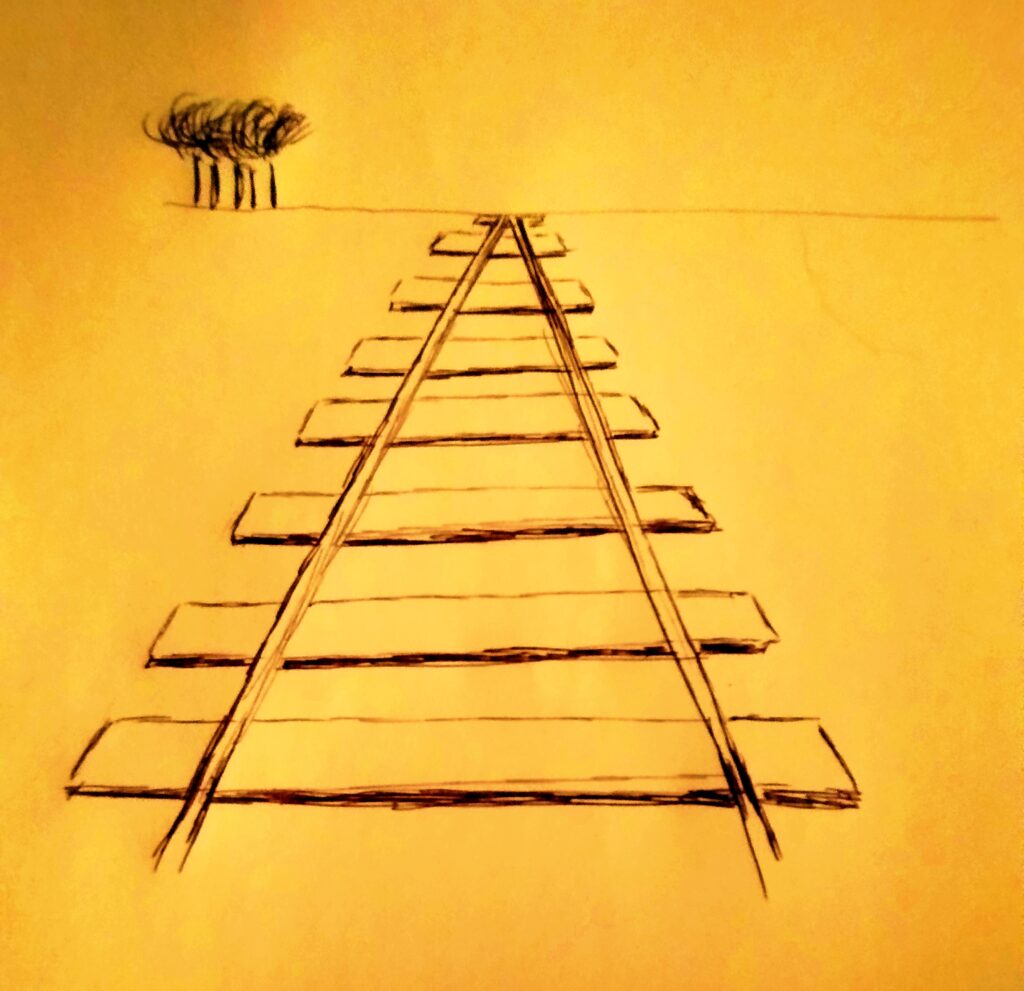
The plain stretched out, it seemed, to infinity. A thin row of trees lined up with the horizon, marking it like a milestone or a gravestone. The plain was stitched with railway tracks, like thread disappearing into the distance. Where those tracks led, what they connected to, and where they ended—no one knew. The rails hadn’t shone in years; they were overgrown with dry grass, rust, and moss. They lay still, like the entire plain.
The station had a reputation for being cursed, as abandoned things always do. Hardly anyone passed that way. The rare passersby, driven by trouble or some unavoidable errand, followed the tracks toward the distant line of trees on the horizon. They lowered their heads and closed their eyes as they passed the station, to avoid the well-known curse. What the curse was, why it had been cast, and what would happen to the cursed—no one ever mentioned.
And so the station endured and decayed, in the middle of the merciless, dry plain.
One morning, just before dawn, the piercing noise of machinery startled the plain. The lights of lamps cut through the twilight, enormous wheels churned up low shrubs, and the voices, laughter, and curses of the workers disturbed the dryness of the quiet. At last, life.
The station fell at the first strike of the digger’s teeth. It collapsed with a sigh of relief. The tracks rose easily, like dead roots. The work went without difficulty, and it seemed the curse was only a myth, an idle tale—as many curses are. A new road would pass through here, connected to others, as roads should be.
Trouble appeared only when they tried to lift the last few meters of track, exactly where the single platform of the dead station had once stood. The rails would not budge. They tried lifting them with a digger, with an excavator, they tried digging around them, splitting them with a pneumatic drill—nothing, absolutely nothing worked.
In the end they decided the rails would be blown up with dynamite. They rigged the charge; the workers hid behind the machines, at a safe distance, and one of them pressed the detonator. A mass of earth and vegetation flew into the air. When the dust settled, the workers could not believe their eyes. The rails and sleepers were untouched. A piece of the railway floated, intact, in its place, as if fastened to the air itself.
The curse was real.
The workers fled, leaving all their machines behind.
Mordekai examined the floating track. Beneath it was a crater carved out by the dynamite. He looked around. The station was now just a pile of boards and beams, stacked into a heap. The machines were already being overtaken by the dry, sickly vegetation and sinking into a deep sleep, the kind that belonged to this plain. Mordekai sighed.
“It’s not wise to meddle with border places,” he thought. “Once they’re built, they shouldn’t be torn down. They should be left as they are.”
He pushed aside a few dusty planks. In the grass remained furrows, like the shadows of the lifted rails, disappearing toward the horizon. The distant row of trees swayed in the wind. Mordekai sat on the floating rails.
“If only people knew… There wouldn’t be so many doors, windows, thresholds, stations and crossroads. If they only knew.”
He decided to sit on the porch of the ruined station, right in front of the floating rails. He lit a cigarette. The sun was slowly fading. With every gust of wind the cigarette glowed brighter.
“At stations, one waits. I will wait. And while waiting, one smokes a cigarette.”
When he finished the cigarette, it came to him. The furrows of the tracks ended with the floating rails. Beyond them, there was no railway. The station where Mordekai waited was a first station—a station that had never had arrivals, a station that led only somewhere else, a station that knew nothing of welcome, only of “farewell.”
This saddened him.
This railway remembered only partings. All the lovers, friends, families who embraced and whispered last advice into each other’s ears, straightened collars one last time, and secretly slipped final coins into pockets. The rails had absorbed every departure, every traveler who walked along them into an unknown life and left someone behind, weeping, to curse the rails that carried away the beloved.
The railway was waiting.
“That’s not right,” thought Mordekai. Then he stood up, looked gently at the floating rails, and said:
“I have arrived.”
The rails and sleepers fell silently into the pit, as into a grave. The first passenger had arrived at the station. Everything was in order.
For departures are always remembered.
Arrivals pass quietly, like the wind that caresses the plain.
More Mordekai Stories: The House Awoken, The Inverted Tree, The Glass Field
