
He had been sitting beneath a tree in the city park for a long time. From there he had a clear view of the promenade, where people passed by absorbed in their everyday errands, or wandered, intoxicated by the mild spring day. Over his left shoulder he could follow the path, children at play, parents calling after them, elderly people sitting on benches, soaking up the sun. To his right stretched a meadow where boys chased a ball, shouting and laughing. Above him, branches swayed in the breeze. From time to time a bird would land, linger briefly, and fly on.
Everything seemed in harmony with the spring day. Everything except him. He sat motionless, too motionless. His gaze drifted from one scene to the next. In his body he felt tension, a repulsive tension that he knew would soon drive him away, forcing him to seek another place from which to observe.
“Nothing,” he whispered to himself, stood up, descended to the promenade, and disappeared into the crowd.
Once, he had been like the others. He walked along promenades, rested in parks, basked in the sun, ate and drank with pleasure, loved, perhaps was even loved, he breathed, breathed freely, with full lungs, inhaling oxygen and exhaling carbon dioxide, like everything that lives in this world. Events and experiences followed one another in their proper order. Some he welcomed with open arms, others he tried to avoid, though they could not be avoided.
He believed, as every person wishes to believe, in order, in logic. He was happy when happiness was called for, mourned when mourning was required. Things followed their course, and he followed along. He was a fish tethered to a fisherman’s boat, and he trusted the fisherman unconditionally. But the fisherman pulled him, following his invisible map, into turbulent, hostile waters.
Each new event sealed off his retreat. With every new day he shifted his ambush farther back, promising himself that this would be the final withdrawal. His pride had turned to dust. He kept repeating to himself: everything that happened could not have been avoided. And now only one thing remained: he must kill.
There was no other way, no other exit. Kill. Not out of anger, rage, or revenge, but out of consistency. All that was missing was a sign, not as permission, but as confirmation. And so he searched. He moved from place to place and watched. Hundreds of times already it had seemed to him that the sign was near, that it was there, that it had revealed itself, that the anxiety would finally fall silent, but nothing. Nothing, and always nothing. He had begun to fear that his logic and the logic of the world were not aligned, and that his life, and the lives of all people, were nothing more than an illusion.
That’s what’s at stake.
That is where everything breaks.
Mordekai was sitting in the garden of a restaurant. He ordered an aperitif and devoted himself to reading the menu. Several times he lifted his head and drew in the scents of the blossoming trees along the boulevard. The sun was shining, the sky clear; only a few clouds, clotted like uncombed wool, drifted through the blue.
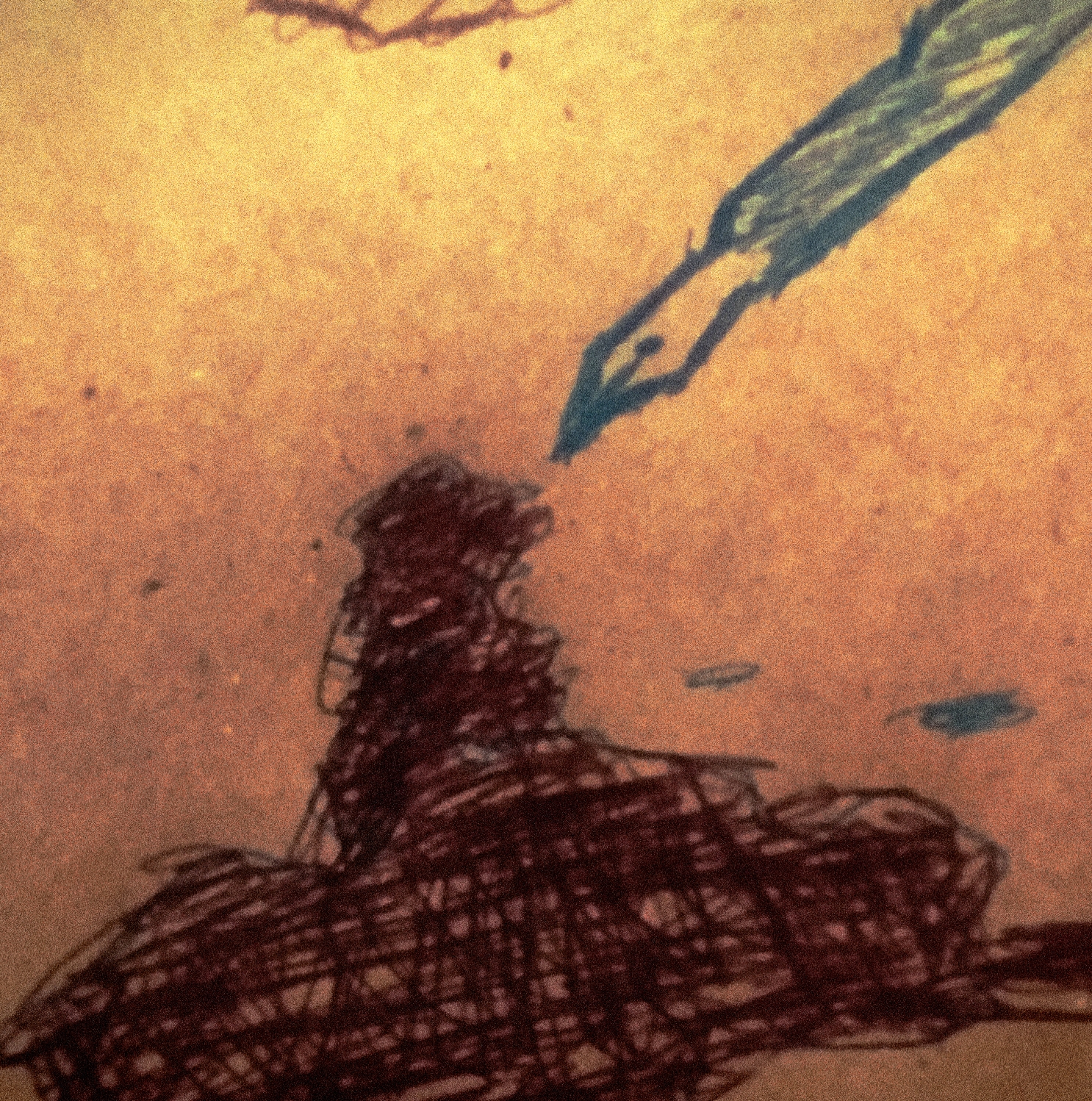
Suddenly, his shirt grew damp. He lowered his gaze and lifted his jacket. A dark blue stain was spreading through the fabric, where the inner pocket of the jacket pressed against it. From that pocket Mordekai pulled out a fountain pen, still dripping ink, onto the jacket, the shirt, the tablecloth. He set the pen down on the tray. He sighed and examined the blue stain. It seemed to him that someone had shouted, “That’s it,” somewhere in the distance. The waiter brought a napkin; Mordekai apologized for making a mess. The napkin did not help. Nothing could be done.
He went on reading the menu.
More Mordekai Stories: The House Awoken, The Inverted Tree, The Glass Field, The Railway in The Plain, The Man Who Was in The Way
