
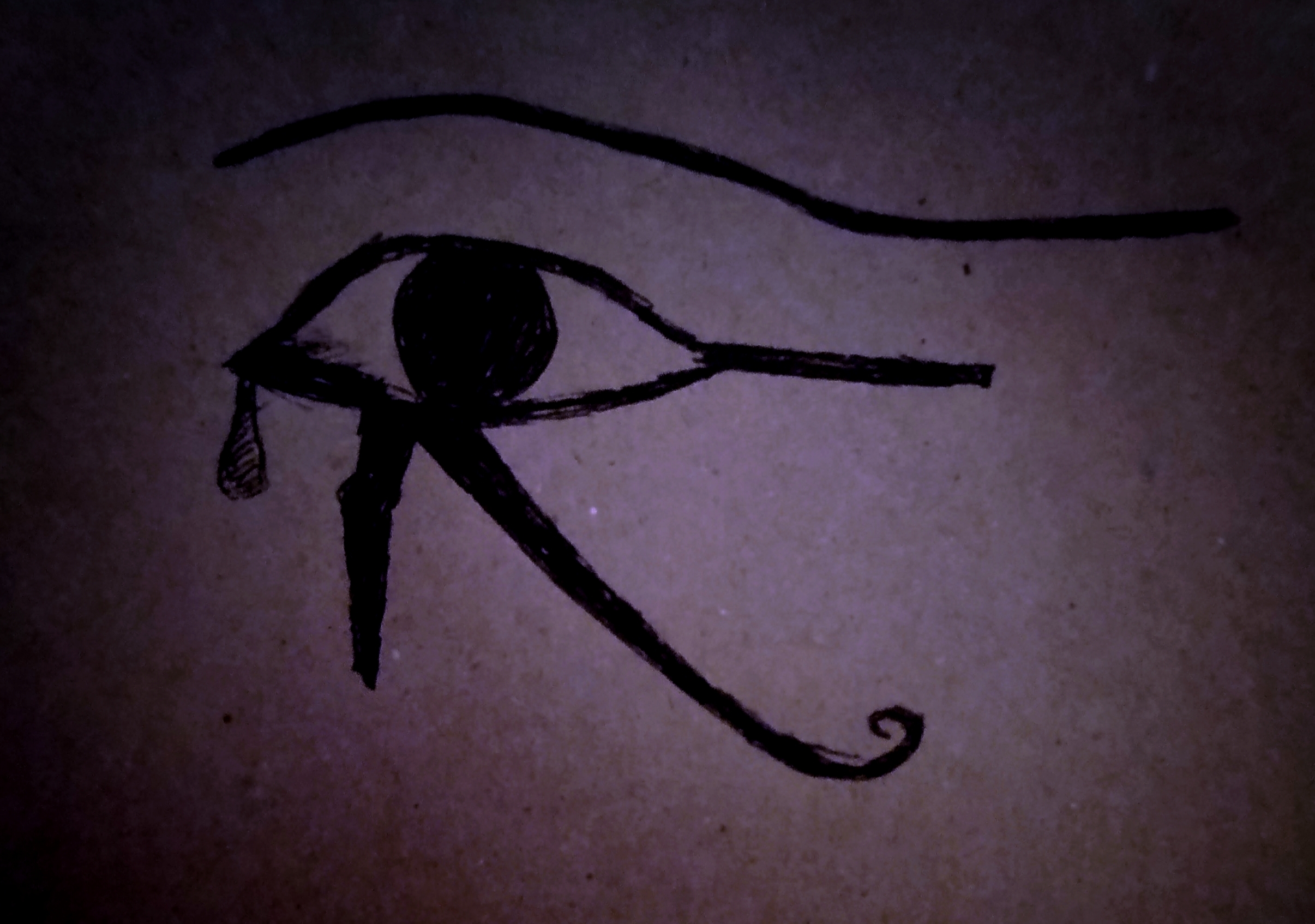
Reading Assmann’s The Search for God in Ancient Egypt, I came across a myth about the creation of humanity.
Atum, the first god, the creator, the one who created himself, found himself alone in the primordial waters of chaos. To ease his loneliness, he spat out two children, Shu and Tefnut. But the waters of chaos were dark and turbulent, and they separated Atum from his children.
He sent his Solar Eye to search for them. The Eye wandered for a long time and finally found Atum’s children. Shu celebrated their discovery by creating a rift in the primordial waters through which the Solar Eye could shine. And so the first sunrise occurred.
When the Eye returned to Atum, it found something unexpected. Atum had a new, replacement Eye that had grown in the meantime. The Solar Eye flew into a rage. Consumed by grief and guilt, Atum began to weep, and his tears blinded him.
From those tears, born of grief and rage, in a moment of divine blindness, humanity came into being.
Assmann, of course, mentions different sources that tell the story in different ways. Egyptian theology differed from city to city and is as complex as it is beautiful. But the essential myth goes roughly as I have told it here.
It was moving to read such a myth, and even more unsettling to digest it, precisely because it makes perfect sense.
The age of Gaza, Trump, Netanyahu, Putin, and the infiltration of fascism into every pore of social life bears witness to that sense. The future does not look good. In fact, in the long run, it looks like a classical dystopia made flesh, a world in which mindless slaves crawl across poisoned and barren land while a wealthy elite watches them from cities in the sky.
History itself, after all, confirms the meaning of this myth. History is no path of progress but, to paraphrase Walter Benjamin, a catastrophic accumulation of ruins.
And could there be a more poetic description, not only of the human being as a creature that must live and then die, but of human history itself, than as the sporadic product of rage, grief and divine blindness? Is humanity’s greedy, violent and unstable nature not the logical fruit of such dark roots?
The ancient Egyptians, one of the first cultures to become conscious of themselves in relation to the world, passed a damning judgement on humanity and forged it into the foundations of their beliefs.
Only thousands of years later has humanity begun to understand that the cosmos does not revolve around it, that human beings are merely another part of the phenomenon of life, and that the concepts of good and evil are utterly alien to the universe.
Something the Egyptians, in a way, already knew.
We display our tears. Sometimes we hide them, and sometimes we take pride in them. We call them sacred. We call them excessive. We try to prevent them or provoke them. We surrender to them, fight them, exploit them, respect them, turn our heads away from them. We write poems and novels about them. We paint pictures of them.
We have a profound relationship with tears, perhaps because we were made from them.
Can tears become something else, something better? We dream of a world without them.
Does that mean a world without people?
In Psalm 56, David gives God his tears as a pledge, as proof of his existence:
…my tears are kept in Your vessel, they are in Your book…
The myth of Atum’s tears punctures holes in our modern, self-satisfied cosmogony. It leaves behind painful questions, carving them with a blade into comfortable, idle minds.
I wish I had never read it.
More in Notebook: Western Ketman and the Captive Mind, The Reading Chain (III), The Reading Chain (II), The Reading Chain (I)
