
Thomas Mann’s Joseph and His Brothers opens with an image of young Joseph gazing into the dark bottom of a well, reflecting on the past. The deeper his gaze penetrates, the darker the reflection becomes, until it finally turns into shadow. Breaking free from the spell of the well, Joseph runs off into his bright day — into the sky, the tents, the goats and the desert that surround him — aware that the light of the world rests upon dark foundations. “Deep is the well of the past,” Mann writes. “Should we call it bottomless?”
For Mann’s novel, myth is the underground continuity of history, a hidden current that follows time’s flow step by step. It is no coincidence that Bruno Schulz held Joseph and His Brothers in exceptionally high regard, recognizing in its well his own obsession — with the dark origin of light, with a world that conceals within itself another world, or rather, in Schulz’s manner, a world pretending to be an entirely different world.
Myth
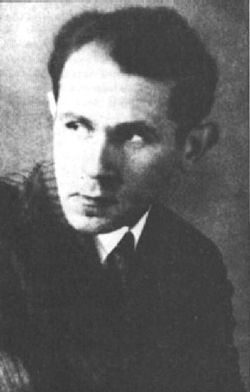
Bruno Schulz was a drawing teacher. He spent his life in Drohobycz, a provincial town in Galicia. Like many towns of Eastern and Southeastern Europe, it endured the noisy shifts of empires and powers: the Polish–Lithuanian Commonwealth, the Russian Empire, the Austro-Hungarian Empire, the Polish Republic, the Soviet Union, and, finally, the Third Reich. The powers rose and fell, and Drohobycz remained silent, rolling back and forth like a stone by the roadside. Schulz rarely traveled, and when he did, he was overtaken by restlessness and a longing to return. Drohobycz was his world. Everything he knew of the world, everything he wished to know, came through the window of his room. Through shop windows. The faces of passersby. From the depths of childhood and, of course, from books.
He was a solitary man, maladjusted and ill at ease in the world he lived in. His true home consisted of books, drawings, and his sensitive mind — arranged like his parents’ old house at the end of the nineteenth century. There he felt safe. His biographer Jerzy Ficowski wrote that Schulz lived his whole life with a sense of imminent danger. That he lost himself completely in large groups, among strangers and unfamiliar environments. He felt like prey to a terrifying uniqueness that marked his existence.
Prose
Schulz wrote two collections of stories: The Cinnamon Shops (Street of Crocodiles) and Sanatorium under the Sign of the Hourglass. A few fragments and several unpublished short pieces were gathered posthumously in The Republic of Dreams. His entire genius fits into three slender books.
All of his stories revolve around his family, their house, and his father’s shop. Schulz’s mythopoetics immortalized everyday family life and raised it to the level of a personal pantheon. Unlike Mann’s historicism in his literary treatment of myth, in Schulz’s stories history is wholly subordinate to myth. The father, the mother, Adela (the maid), he himself, and his native Drohobycz all become mythical versions of themselves — not better or worse, but more authentic, more primal, more significant.
The fact that Schulz called himself “Joseph” in his stories already speaks of his connection to Mann’s novel. Much has been written about his kinship with Kafka, especially because Schulz’s alter ego shares a name with Josef K. from The Trial. Yet it is hard to imagine Kafka’s deranged, bureaucratized, cold Josef K. lost in thought, gazing into the mythical depths of the Well of History.
The resemblance in metamorphosis is also different. Kafka’s Gregor Samsa is a helpless victim — not only of the mysterious transformation but also of his petty bourgeois family, whose relationships are equally bureaucratic. Schulz’s father, on the other hand, turns into a crab that the family accidentally cooks — but even so, steaming and puffing, he escapes from the pot and continues living somewhere else, in another mythical reality. And that is only one of the father’s metamorphoses. Each of them the family honors almost religiously, adapting their lives to his transformation. None of them are Kafkaesque nightmares — they are the birth of new myths, vital and playful.
Matter
Schulz’s mythopoetics are far more Spinozist. He transformed Spinoza’s maxim Deus sive natura into something else: God is matter that plays, that breathes, dreams, and endlessly changes its form. God is not beyond it, but within its transformation. Spinoza sought God through geometry; Schulz through imagination. “There is no dead matter. Lifelessness is only an illusion behind which unknown forms of life hide. Things disguise themselves, change masks, to protect themselves from our gaze.” Thus Schulz explained his monism — not so different from Spinoza’s, yet warmer, more human.
The Father
The father, Jakub (Mann’s Joseph!), is the central figure of Schulz’s mythology. He is an eccentric who physically disappears, a king of the bird kingdom in Birds. A prophet of a mysterious demiurge in Treatise on Tailor’s Dummies. An insect in Cockroaches, an immortal in Sanatorium under the Sign of the Hourglass. He is a protean, elusive, almost primordial figure. Comparing Schulz’s Jakub to Danilo Kiš’s literary father, Eduard (from Garden, Ashes and Hourglass), one finds similar obsessions, a fixation of the same intensity.
The difference lies in the literary method: Kiš reconstructs his father through a document — a letter surviving the storm of war — filling the gaps with carefully controlled imagination. Schulz, on the other hand, detaches his father from any reality, any documentary trace, and mythologizes him completely. That does not mean Schulz’s prose belongs to fantasy. It breathes with reality — but the writer’s own reality. There is nothing chaotic in it. His style bears the mask of realism, concealing an unrepeatable world — an Atlantis that never surfaced.
The city
Drohobycz is the second axis of Schulz’s mythology. In The Cinnamon Shops and Crocodile Street, young Joseph wanders the streets, gazing into shop windows, at passersby, at the façades of buildings. Step by step, they all transform into mythological versions of themselves. Drohobycz is the stage of Schulz’s world — Olympus or Hades, depending on need. This small town at the margins of great empires, in the story The Republic of Dreams, becomes a state — independent of economy, industry, and technology. It enters a state of essence, of dream. World politics, wars, redrawn borders no longer concern it. Inflation, crises, industrialization do not touch it. The Republic of Dreams exists beyond all that.
In that story, Schulz seems to say: if the physical, material Drohobycz is doomed to perish, its twin — the Republic of Dreams — will live forever.
In 1941, Nazi troops entered Drohobycz. Unable to obtain the title of a “useful Jew” from the local Judenrat, Schulz entered the service of Gestapo officer Felix Landau. He painted murals in Landau’s house, in the Gestapo school and headquarters. In exchange for his work, Landau took him under protection, making him his “personal Jew.” Schulz moved from his family home into the Jewish ghetto, where hunger, cold, and disease reigned. He tried to work on his novel The Messiah, unsuccessfully.
The Angel of History
In November 1942, Schulz was returning home with a loaf of bread under his arm. Crossing the street, he was shot by Karl Günther, a Gestapo officer and Landau’s rival. Günther was angry because Landau had killed his own “personal Jew,” a dentist named Löw, a few days earlier. Günther reportedly informed Landau of Schulz’s death, saying: “Now we’re even.”
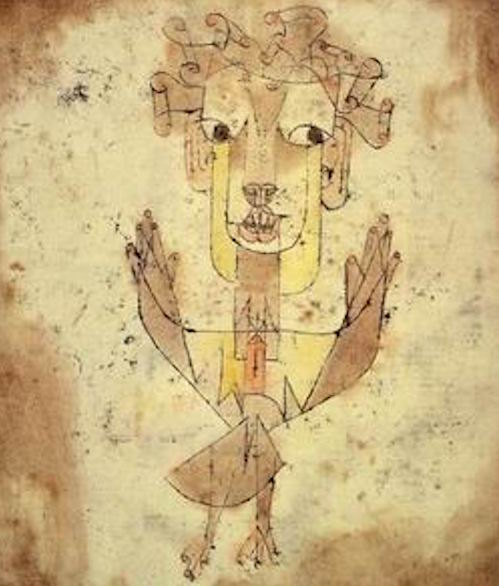
Walter Benjamin, in his Theses on the Philosophy of History, writes about Paul Klee’s painting Angelus Novus:
“A Klee painting named Angelus Novus shows an angel looking as though he is about to move away from something he is fixedly contemplating. His eyes are staring, his mouth is open, his wings are spread.
This is how one pictures the angel of history. His face is turned toward the past. Where we perceive a chain of events, he sees one single catastrophe which keeps piling wreckage upon wreckage and hurls it in front of his feet.
The angel would like to stay, awaken the dead, and make whole what has been smashed. But a storm is blowing from Paradise; it has got caught in his wings with such violence that the angel can no longer close them.
This storm irresistibly propels him into the future to which his back is turned, while the pile of debris before him grows skyward. This storm is what we call progress.”
The small, timid, solitary genius Bruno Schulz found himself beneath the wings of Benjamin’s angel and the storm of Paradise. Caught between the millstones of History, he vanished — like a dog shot on a winter night — deprived of the angel’s help. How many geniuses have vanished at the hands of mediocrity!
Republic of Dreams
Like Benjamin, Schulz believed that the world of dreams and myths does not vanish with the appearance of history, but retreats into its cracks. His Republic of Dreams and Benjamin’s Angel of History are two poles of the same vision: one looks inward, into the endless depths of imagination; the other outward, into the ruins of the world. Both, each in their own way, tried to awaken dead things — one through dreams, the other through the fragments of history.
Schulz’s unfinished novel The Messiah has disappeared without a trace. That lost book has gained a cult status, like Aristotle’s Comedy. Even in disappearance, Schulz mythologized himself, wrapping his life in mystery. Perhaps, in the moment of his death, he was chosen as the ruler of the Republic of Dreams. Perhaps that metaphysical state, that utopia, hovers somewhere above us — guarding our thoughts, our imagination. Our dreams.
Schulz himself once wrote: “There is an idea that no dream, however absurd or impossible, is ever lost in the universe.”
Perhaps all writing, in the end, comes down to the attempt to find that unmarked road — the road to the Republic of Dreams.
For more Apocrypha read further: The Dream and Tragedy of David Lindsay: The Forgotten Prophet of Arcturus
